MoCA3D: Monocular 3D Bounding Box Prediction in the Image Plane
ECCV 2026
Abstract
Monocular 3D object understanding has largely been cast as a 2D RoI-to-3D box lifting problem. However, emerging downstream applications require image-plane geometry, such as projected 3D box corners, which cannot be easily obtained without known camera intrinsics. This is a fundamental limitation for object understanding in the wild, where camera metadata is often unavailable or unreliable.
We introduce MoCA3D, a monocular, class-agnostic 3D model that predicts projected 3D bounding box corners and per-corner depths without requiring camera intrinsics at inference time. MoCA3D formulates pixel-space localization and depth assignment as dense prediction through corner heatmaps and depth maps.
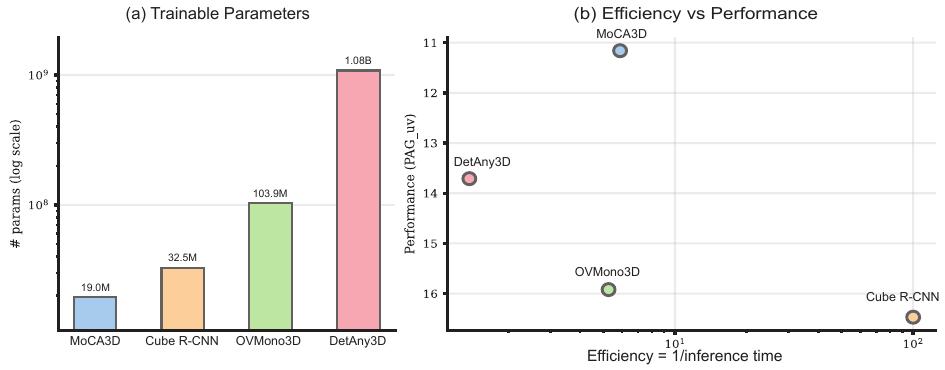
To evaluate image-plane geometric fidelity, we propose Pixel-Aligned Geometry (PAG), which directly measures projected-corner and depth consistency. Extensive experiments show that MoCA3D improves image-plane corner PAG by 22.8% while remaining competitive on 3D IoU and using up to 57× fewer trainable parameters than prior lifting approaches.
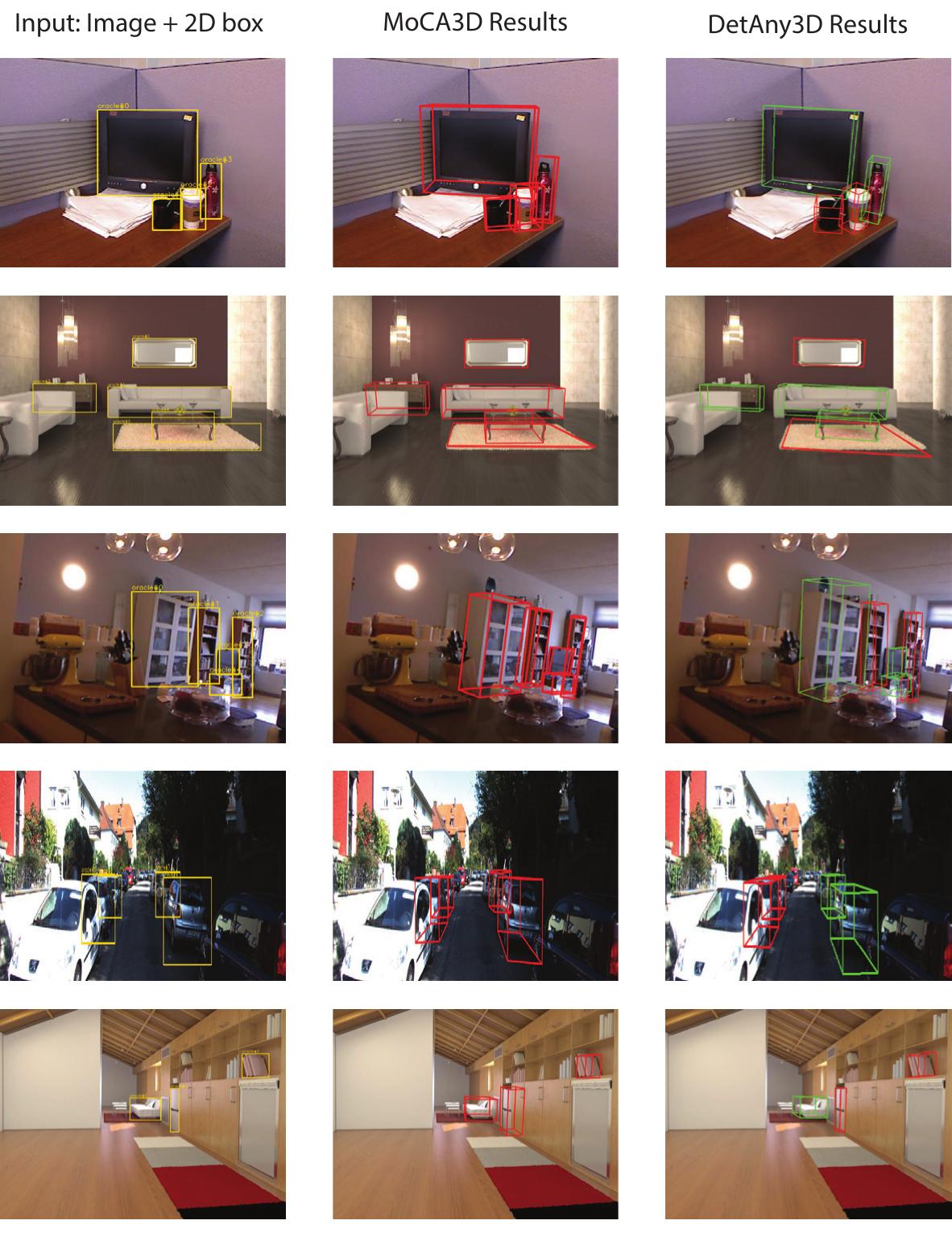
Qualitative Results
Motivation
No camera intrinsics
Predict projected 3D geometry from only an RGB image and a 2D box.
Dense supervision
Learn corner heatmaps and depth maps instead of a sparse regression vector.
Directly usable geometry
Output pixel-aligned corner-depth pairs for downstream image-space tasks.
Conventional monocular 3D methods predict a cuboid in camera coordinates and then project it back to the image. This requires camera intrinsics, which are often missing or unreliable in real-world images. Direct corner regression avoids calibration, but provides only sparse supervision.
MoCA3D resolves both limitations by predicting eight projected corners and their depths as dense heatmaps and depth maps. The resulting representation stays aligned with image pixels and can be used directly for controllable generation, image editing, robotics, and spatial control.
Method
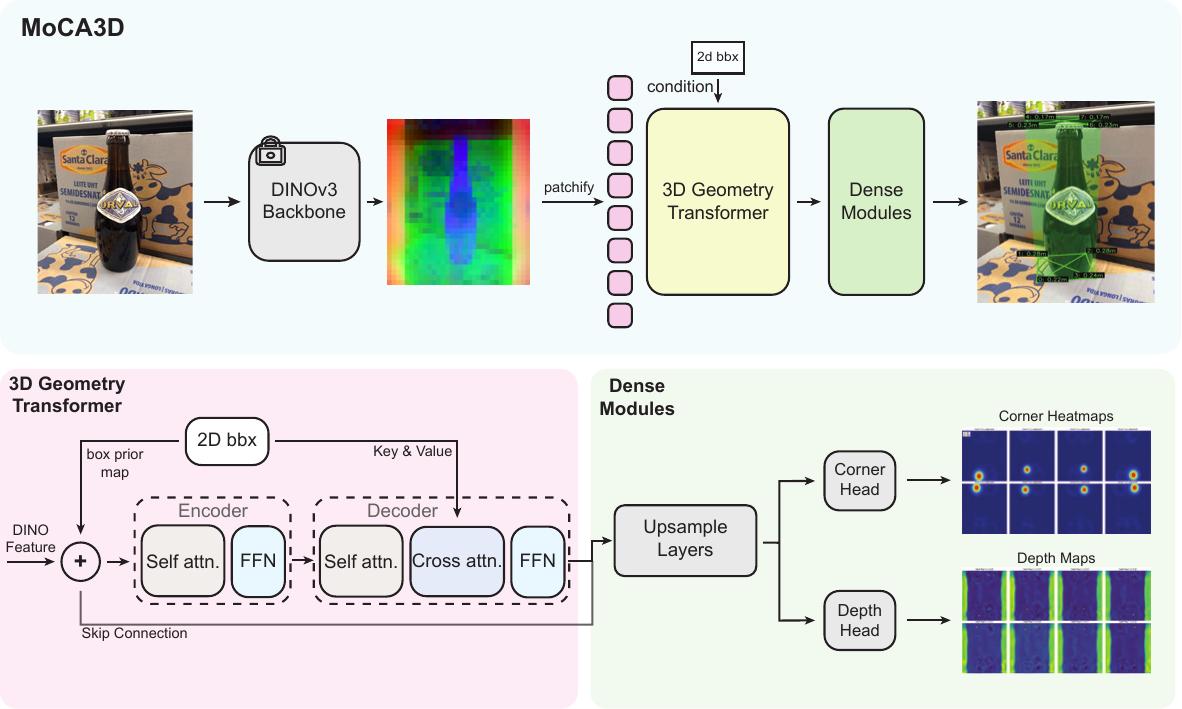
A box-conditioned transformer turns frozen image features into eight corner heatmaps and corresponding depth maps.
1. Image features
A frozen DINOv3 backbone extracts geometry-aware features from the complete image rather than an isolated object crop.
2. Box conditioning
A relative-coordinate box prior conditions the encoder, while box embeddings provide keys and values to the decoder so every image token can reason about the target instance.
3. Dense prediction
Lightweight upsampling layers feed corner and depth heads that recover eight pixel-aligned corner-depth pairs.
Why dense prediction?
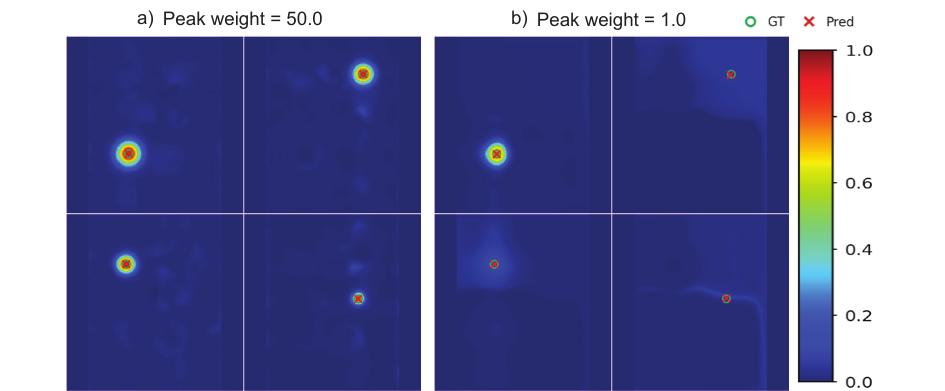
Each of the eight heatmaps is converted into a continuous corner coordinate using differentiable soft-argmax. Peak-weighted supervision emphasizes the region around the ground-truth mode, improving sub-pixel localization and stabilizing coordinate refinement.
The predicted heatmaps also act as confidence maps for per-corner depth supervision. Depth is sampled at the recovered corner location, keeping localization and depth assignment aligned by construction.
Experiments
We evaluate image-plane and 3D-space geometry under a shared oracle-2D-box protocol across six domains.
22.8%
better corner PAGuv
19.0M
trainable parameters
57×
fewer trainable parameters
Pixel-Aligned Geometry
PAGuv measures projected-corner error in pixels, while PAGd measures relative depth error at the eight corners. These metrics expose reprojection failures that may be obscured by conventional 3D box metrics.
MoCA3D achieves the best PAGuv across all six evaluated domains and ranks second overall on PAGd. It remains competitive on NHD and IoU3D despite not explicitly regressing a camera-space cuboid.
The model uses 19.0M trainable parameters, compared with 1.08B for DetAny3D, while offering a favorable inference-time and image-plane accuracy trade-off.
Downstream Application
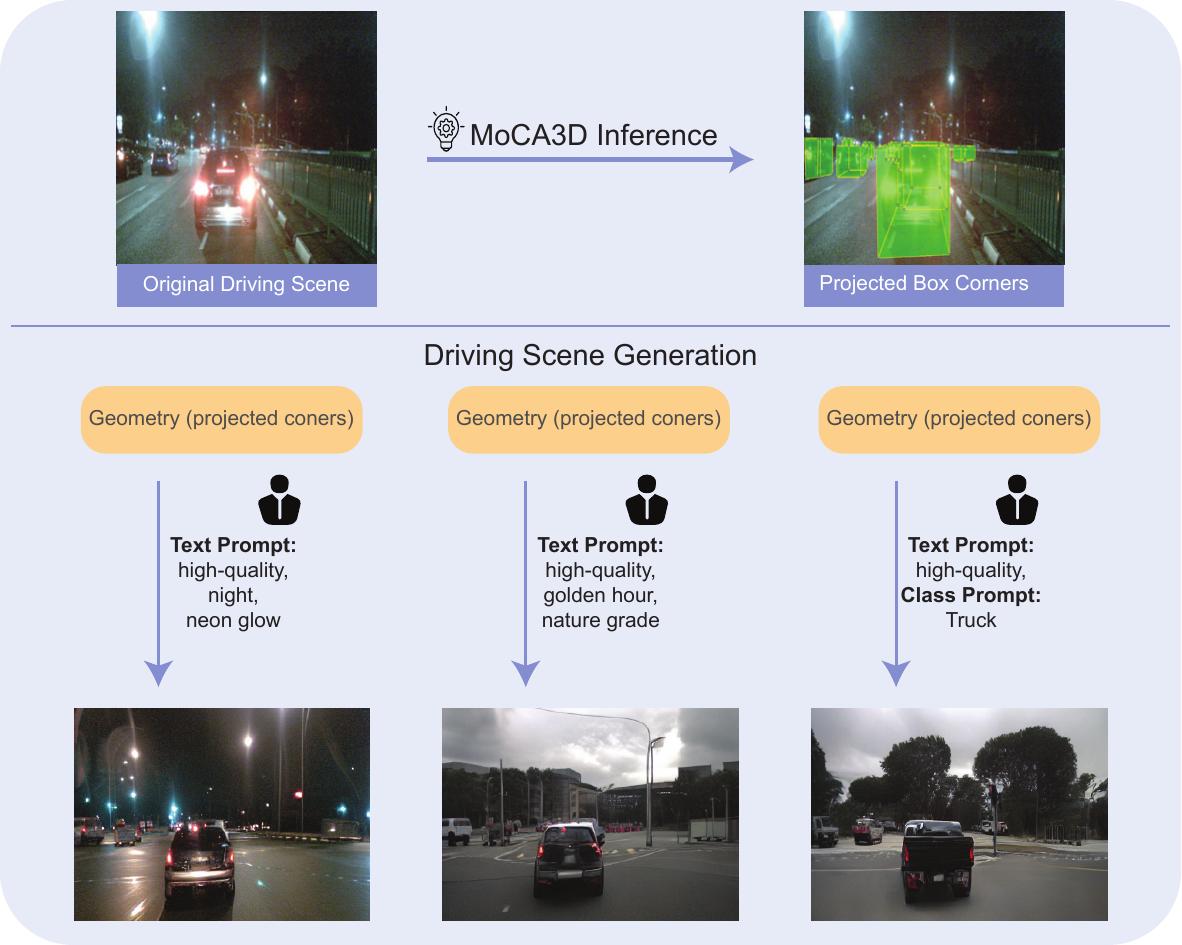
Pixel-aligned projected geometry enables controllable generation without test-time camera calibration.
MoCA3D outputs projected corners in the coordinate system directly consumed by layout- and geometry-conditioned generation models. This avoids reconstructing camera calibration or repeatedly converting between image and camera coordinates.
In driving-scene generation, the recovered boxes preserve perspective and depth ordering while allowing appearance, lighting, and object class to be changed independently.
BibTeX
@article{jeon2026moca3d,
  title={MoCA3D: Monocular 3D Bounding Box Prediction in the Image Plane},
  author={Jeon, Changwoo and Upadhyay, Rishi and Kadambi, Achuta},
  journal={arXiv preprint arXiv:2603.19538},
  year={2026}
}